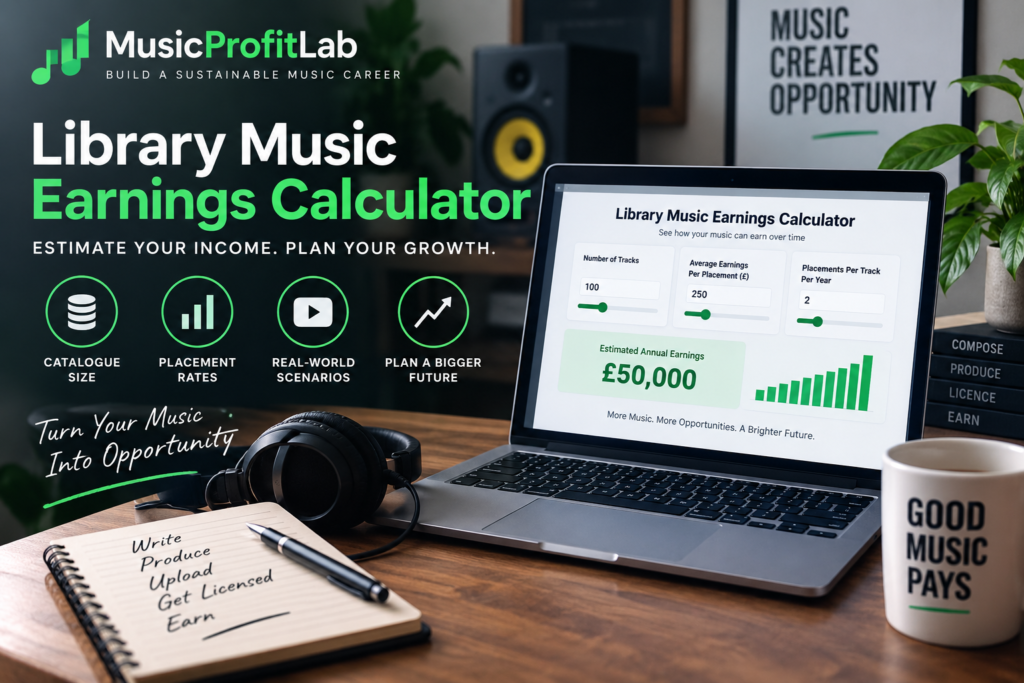
🎼 Library Music Earnings Calculator
Estimate your potential library music income based on your catalogue size, average placements and earnings per placement.
How Library Music Earnings Are Calculated
Library music income varies depending on the quality of your catalogue, the number of placements, the libraries you work with and the types of productions using your music. This calculator provides an estimate based on the number of tracks you own, the average number of placements per track each year and the average income earned from each placement.
Actual earnings can vary significantly depending on performance royalties (PRO), sync fees, publisher splits, territory, contract terms and whether placements are on television, streaming platforms, advertising or film.
These figures are estimates only and should be used as a guide, not a guarantee of future earnings.
How much can library music earn?
Library music earnings vary widely depending on the quality of your catalogue, the libraries you work with and how often your music is licensed. Some composers earn a few hundred pounds a year, while established library composers can generate thousands or even a full-time income.
How many tracks do I need to make a full-time income?
There is no fixed number. Success depends on the quality of your music, the demand for your genres, the libraries you partner with and the frequency of placements. Many successful library composers build catalogues containing hundreds of tracks over several years
Do library composers receive performance royalties?
Yes. In many cases, composers receive performance royalties through their Performing Rights Organisation (PRO) when music is broadcast on television, radio or certain streaming services. These royalties are separate from any upfront sync or licence fees.
Understanding Library Music Earnings
A library music earnings calculator can help composers estimate the potential income from a production music catalogue. Your results will depend on several factors, including the number of tracks you have available, how frequently those tracks are licensed, the type of production using the music and the amount earned from each placement.
For example, a larger catalogue gives you more opportunities for placements, while tracks that are well suited to television, film, advertising, online video and other productions may have different earning potential. Some placements may generate a licence or sync fee, while broadcast uses can also generate performance royalties through a performing rights organisation (PRO), depending on the territory and the terms of your agreement.
There is no fixed number of tracks required to generate a particular income. A composer with a small catalogue may occasionally receive valuable placements, while another composer may build a much larger catalogue and generate income from a greater number of uses over time.
Use the library music earnings calculator above to experiment with different catalogue sizes, placement rates and earnings per placement. For example, you can compare the potential annual income from 25, 50, 100 or more tracks and see how changes in placement frequency affect the estimate.
Remember that these figures are estimates rather than guaranteed earnings. Actual library music income can vary considerably according to the libraries you work with, your contracts, the markets your music reaches and how often your tracks are selected for productions.
What affects library music earnings?
Library music earnings can vary depending on the number of tracks in your catalogue, the genres you produce, the libraries you work with and how frequently your music is selected. Building a larger catalogue can create more opportunities for placements, while strong metadata, professional production and music that fits current production needs can help your tracks get discovered and licensed.
Related Music Calculators
- Music Streaming Royalties Calculator
- Music Royalties Split Calculator
- Spotify Income Goal Calculator (Coming Soon)
- Free Music Tools